
A single raindrop doesn’t seem like much, but as we look for a more sustainable future, it’s anything but. Every drop is part of a shared water cycle, and how we capture, convey, store and treat stormwater helps shape how we protect the world’s most precious resource and the communities and ecosystems that rely on it.
That mission sits at the heart of Advanced Drainage Systems (ADS). From the moment rain hits the ground until it’s treated and returned to lakes and streams, ADS helps manage stormwater. In fact, ADS has more than 14 billion feet of pipe in service across the U.S. and internationally—quietly working beneath communities every day to move and manage water.
AT&T’s advanced connectivity supports ADS’ efforts to innovate across the lifecycle of a raindrop at every stage.
ADS is developing and scaling next-generation stormwater solutions with its 110,000-square-foot ADS Engineering and Technology Center and new headquarters at the center—both powered by AT&T Business Fiber. Designed to be the most advanced stormwater engineering center in the world, the facility brings together research and development, consolidates testing operations and strengthens manufacturing engineering development, helping ADS think bigger about what’s possible.

“Our reason is water, and managing the lifecycle of a raindrop takes innovation in the lab and precision in the field,” said James Kline, chief information officer at Advanced Drainage Systems. “That’s why a reliable, secure connectivity provider matters. AT&T’s high-speed fiber has strengthened performance, data reliability and collaboration across our sites, giving teams faster access to systems, more dependable communications and improved uptime. Looking ahead, connectivity opens the door to smarter, more adaptive stormwater infrastructure—ultimately supporting more resilient communities and more sustainable use of resources.”
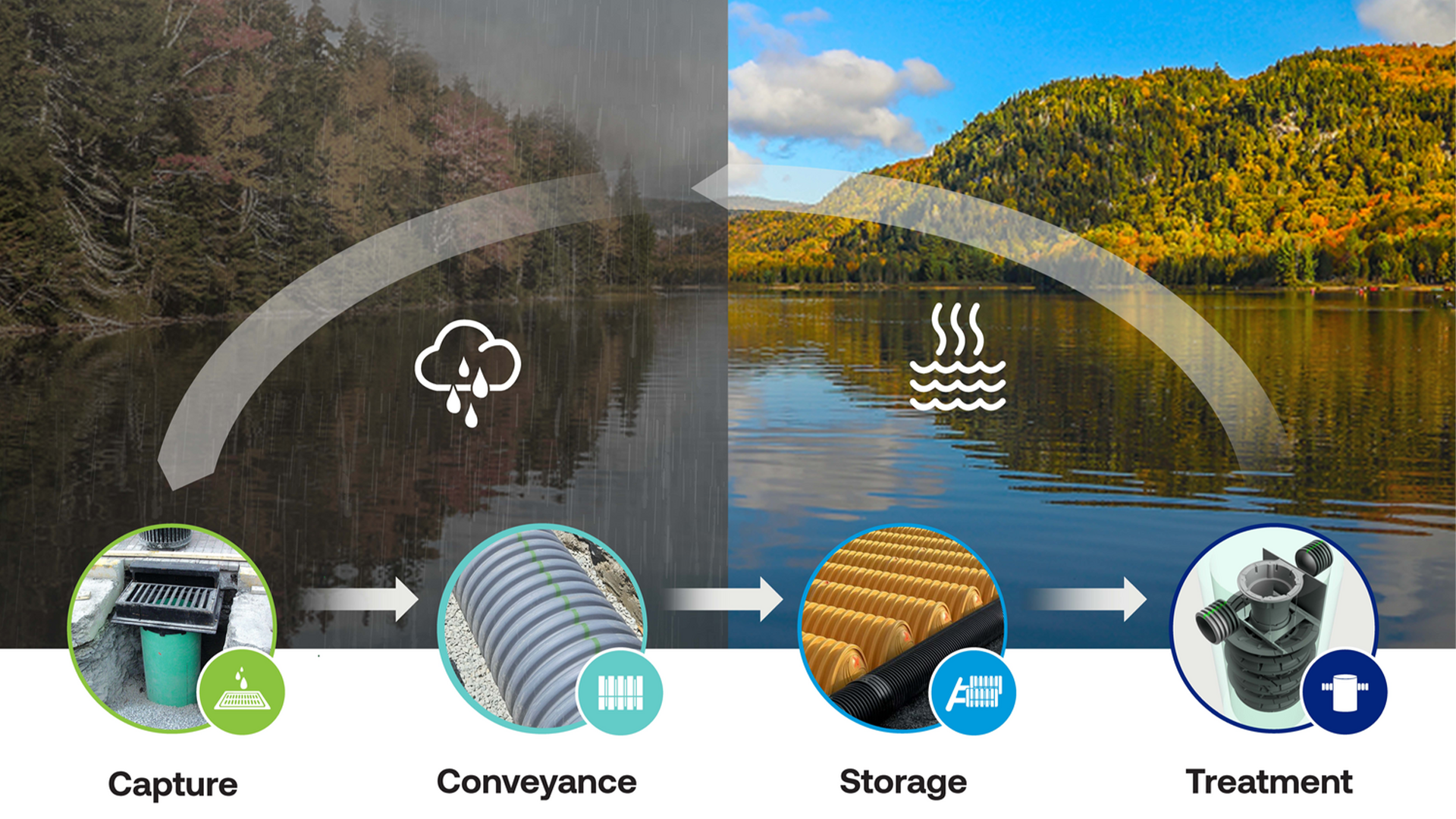
Capture
Stormwater management starts at the surface where rain first hits the ground and needs to be collected safely. ADS’ basins and linear drains capture rain and route it into drainage systems, which keep parking lots and roads safer during storms.
This first phase is also where innovation can create meaningful downstream impact. Better capture reduces the chance of standing water, helps limit erosion and sets the stage for more controlled conveyance and treatment.
It’s also where innovation plays an important role. As ADS expands testing and R&D at its Engineering and Technology Center, connectivity is behind the scenes, helping teams collaborate, share data, and accelerate the cycle from design to deployment. With AT&T Business Fiber supporting day-to-day operations, engineers and product teams can move faster from concept to validated performance.
Fast, reliable connectivity also influences every layer of the business where data integration and real-time communication improve planning accuracy, manufacturing efficiency, logistics coordination and overall lifecycle management of critical water infrastructure. By standardizing high-speed connectivity across facilities, ADS has reduced manual processes and rework, which translate into time savings, improved throughput and greater operational accuracy.
Convey
Once stormwater is captured, it has to move. Conveyance is what helps prevent overflow, reduces flooding risk and supports safer, more resilient infrastructure.
Stormwater travels through ADS’ specialty pipe and drainage solutions designed to address long-term water management needs—from stormwater runoff management to rainwater harvesting efforts aimed at improving land fertility, urban environments and sustainability outcomes.
Moving water is one part of the story. Moving information is another.
ADS operates at a scale that blends manufacturing and logistics across a diverse network of facilities. Their operation supports production and distribution of fabricated fittings, pipe and chambers, with materials staged outdoors in yard environments that can vary widely in size by location—many in rural areas. This expansive operational footprint makes reliable connectivity essential, linking employees, connected endpoints, sites and systems so the business can coordinate production, monitor operations and keep materials moving.
Integrated connectivity across manufacturing and distribution sites has helped shorten decision cycles by enabling systems that give teams near-real-time visibility into operations, inventory and logistics. AT&T has also supported ADS in new construction projects by helping enable connectivity from the start, creating opportunities for resilient network design as facilities grow.
And conveyance isn’t only about stormwater. It’s also about moving essential products where they need to go. ADS’ fleet is a critical part of the equation. With large products and complex logistics, connected fleet operations help keep deliveries reliable and efficient. ADS uses telematics and vision systems as part of its fleet strategy, and AT&T connectivity supports tools including AT&T tablets used by drivers to record transactions and complete in-cab tasks.
Store and Treat
Not every raindrop can be rushed downstream. In many systems, stormwater needs to be temporarily stored and filtered before it returns to the environment.
ADS’ storage products like chambers and crates help filter and hold stormwater until it can be absorbed into the ground. In detention processes, runoff can be stored temporarily and then conveyed into water quality products designed to remove pollutants, debris and toxic materials, helping protect lakes, streams and waterways.
This is also where the intersection of sustainability and innovation is especially clear: the goal isn’t just moving water away from where it falls, but helping return it more safely to nature.
Connectivity supports that innovation pathway. With the Engineering and Technology Center accelerating development of next-generation stormwater and water quality solutions, ADS is also exploring what’s next—where connected capabilities can help unlock new insights, new efficiencies and new approaches to environmental stewardship.
And connectivity is also playing a role in ADS’ circular manufacturing efforts. AT&T connectivity at ADS recycling operations helps enable the recycling of more than 500 million pounds of post-consumer and post-industrial material annually—material that is transformed into a high-quality product designed to last more than 100 years.
Impact
“Our work with ADS is focused on helping them innovate faster and operate with confidence, because when connectivity is reliable, secure and scalable, it becomes a true business enabler,” said Zee Hussain, senior vice president, Global Enterprise Solutions, AT&T Business. “This use case applies beyond ADS— whether you’re a manufacturer with distributed sites, a logistics and transportation provider connecting fleets or a utilities company with mobile field teams, you need a network foundation you can count on. From powering the ADS Engineering and Technology Center to supporting connected operations across distributed sites and fleets, we’re proud to deliver the network foundation ADS relies on to serve customers, scale efficiently and drive meaningful impact in the communities they support.”
When you follow the lifecycle of a raindrop—from when it lands, to how it’s captured, conveyed, stored and treated—you see a system that depends on connectivity.
It depends on the ability to design smarter, test faster, operate across distributed locations and continuously improve how water is protected. With AT&T’s advanced connectivity—fiber today and potential private cellular and Internet of Things (IoT) capabilities ahead—ADS is building a digital foundation designed to scale innovation towards better sustainability outcomes.
Connecting changes everything. It connects engineering teams to the data that accelerates product development. It connects facilities and yards to the systems that keep operations running smoothly. It connects drivers and fleets to tools that improve delivery efficiency. And ultimately, it helps connect communities to cleaner waterways and more resilient, sustainable infrastructure.
As we celebrate Earth Month, the message is simple: protecting water takes more than pipe and products. It takes connected collaboration, smarter infrastructure and shared commitment to safeguarding the environment—one raindrop at a time.