AT&T Inc. (NYSE: T) reported strong second-quarter results, driven by consistent execution of the Company’s investment-led strategy, demonstrating improved growth in consolidated service revenue and profitability. The Company continues to grow its base of high-value converged customers as it delivered a record quarter for combined fiber and fixed wireless net adds and its strongest consumer postpaid wireless account growth in more than three years.
"The accelerated growth we delivered this quarter shows our structural advantages to lead the next era of connectivity,” said John Stankey, AT&T Chairman and CEO. “We are accelerating the pace of our planned share repurchases this year to approximately $10 billion, reflecting our confidence in our market position. With an industry-leading position in fiber – the best connectivity technology available – we believe our network performance and operating scale can’t be matched.”
Second-Quarter Consolidated Results1
- Revenues totaled $31.6 billion, up 2.3% from the year-ago quarter
- Diluted EPS from continuing operations was $0.66, versus $0.62 in the year-ago quarter; adjusted EPS* was $0.65, versus $0.54 in the year-ago quarter
- Operating income was $7.0 billion; adjusted operating income* was $7.5 billion
- Income from continuing operations was $5.0 billion, up 3.6% year over year; adjusted EBITDA* was $12.3 billion, up 5.2% year over year
- Cash from operating activities from continuing operations was $10.8 billion, versus $9.8 billion in the year-ago quarter
- Capital expenditures related to continuing operations were $5.7 billion; capital investment* was $6.1 billion
- Free cash flow* was $4.7 billion, versus $4.4 billion in the year-ago quarter
Second-Quarter Highlights
- Added over 1 million Advanced Connectivity customers, driven by year-over-year increases in net adds across fiber, fixed wireless, and postpaid phone subscribers
- Advanced Connectivity service revenue of $23.5 billion, up 5.1% year over year
- Advanced Connectivity operating income of $7.3 billion, up 20.3% year over year with EBITDA* of $12.0 billion, up 8.0%
- 42.5% of households with AT&T's advanced home internet services also chose AT&T wireless2
- 646,000 total consumer and business Advanced Connectivity internet net adds, including 367,000 fiber and 279,000 fixed wireless
- 432,000 postpaid phone net adds with postpaid phone churn of 0.86%
- Added more than 1 million total consumer and business locations reached with fiber for a total of 38.6 million; the Company remains on track to reach over 40 million total fiber locations by the end of 2026 and more than 60 million by the end of 20303
- Returned $4.1 billion to shareholders, including approximately $2.2 billion in common share repurchases under the 2024 authorization
Outlook and Capital Allocation Plan
AT&T maintains its outlook for improved growth in adjusted EBITDA* and adjusted EPS* and higher free cash flow* through 2028, its plans to return $45 billion+ to shareholders during 2026-2028 through dividends and share repurchases, and an expectation that its net debt-to-adjusted EBITDA ratio* will return to a level consistent with its target in the 2.5x range within approximately three years following the closing of its transaction with EchoStar.
The Company’s long-term outlook for 2026-2028 includes4:
- Service revenue growth in the low-single-digit range annually
- Advanced Connectivity service revenue growth in the mid-single-digit range annually, including expected growth of 5%+ in 2026
- Legacy service revenue decline of 20%+ in 2026 and be immaterial by the end of 2029
- Adjusted EBITDA* growth in the 3% to 4% range in 2026, improving to 5% or better in 2028
- Advanced Connectivity EBITDA* growth in the mid-to-high-single-digit range annually, including expected growth of 6%+ in 2026
- Legacy EBITDA* expected to turn negative after 2027, until AT&T has substantially eliminated direct costs associated with operating its copper-based network5
- Adjusted EPS* of $2.25 to $2.35 in 2026 with a double-digit 3-year CAGR through 2028
- Capital investment* in the $23 billion to $24 billion range annually during 2026-2028
- Free cash flow* of $18 billion+ in 2026, $19 billion+ in 2027, and $21 billion+ in 2028
- Strong capital returns, including plans to maintain its current annualized common stock dividend of $1.11 per share and approximately $24 billion of share repurchases, including approximately $10 billion during 2026
Note: AT&T’s second-quarter 2026 earnings conference call will be webcast at 8:30 a.m. ET on Wednesday, July 22, 2026. The webcast and related materials, including financial highlights, will be available at investors.att.com.
Consolidated Financial Results
- Revenues for the second quarter totaled $31.6 billion, versus $30.8 billion in the year-ago quarter, up 2.3%. This was largely due to growth in Advanced Connectivity fiber and wireless revenues, with fiber revenues including the impact of our first-quarter acquisition of Lumen’s mass markets fiber business. Revenues in Mexico were also higher due to favorable foreign exchange impacts. Offsetting these increases were lower Legacy revenues from lower demand for services as the Company continues to decommission its copper-based network.
- Operating expenses were $24.5 billion, versus $24.3 billion in the year-ago quarter. Operating expenses increased due to an asset abandonment charge associated with the reprioritization of the Company’s spectrum strategy, higher advertising expense, incremental customer costs related to the acquired mass markets fiber business, and higher bad debt expenses driven by subscriber growth. These increases were largely offset by lower depreciation expense from fully depreciated legacy assets, partially offset by ongoing capital spending for strategic initiatives. Also offsetting the increase were cost reductions from transformation initiatives, lower content licensing fees, and gains on tower transactions.
- Operating income was $7.0 billion, versus $6.5 billion in the year-ago quarter. When adjusting for certain items, adjusted operating income* was $7.5 billion, versus $6.5 billion in the year-ago quarter.
- Income from continuing operations was $5.0 billion, versus $4.9 billion in the year-ago quarter, which included equity in net income of DIRECTV.
- Income from continuing operations attributable to common stock was $4.6 billion, versus $4.5 billion in the year-ago quarter. Earnings per diluted common share from continuing operations was $0.66, versus $0.62 in the year-ago quarter. Adjusting for $(0.01), which includes a benefit from tax items that were primarily offset by an asset abandonment charge, and transaction, legal, and other items, adjusted earnings per diluted common share* was $0.65, versus $0.54 in the year-ago quarter.
- Adjusted EBITDA* was $12.3 billion, versus $11.7 billion in the year-ago quarter.
- Cash from operating activities from continuing operations was $10.8 billion versus $9.8 billion in the year-ago quarter, which benefitted from $0.3 billion of cash received from DIRECTV, net of related tax payments. The increase reflects lower cash tax payments and timing of working capital payments, which were partially offset by a voluntary pension plan contribution of $100 million.
- Capital expenditures related to continuing operations were $5.7 billion, compared to $4.9 billion in the year-ago quarter. Capital investment* totaled $6.1 billion, versus $5.1 billion in the year-ago quarter. Cash payments for vendor financing totaled $0.4 billion, versus $0.2 billion in the year-ago quarter.
- Free cash flow* was $4.7 billion, versus $4.4 billion in the year-ago quarter.
- Total debt was $144.0 billion at the end of the second quarter, and net debt* was $126.4 billion.
Segment Results6
Advanced Connectivity service revenues grew 5.1% year over year, driving growth in operating income of 20.3% and EBITDA* of 8.0%. Internet net adds were 646,000 — comprised of 367,000 fiber and 279,000 fixed wireless — and postpaid phone net adds were 432,000.
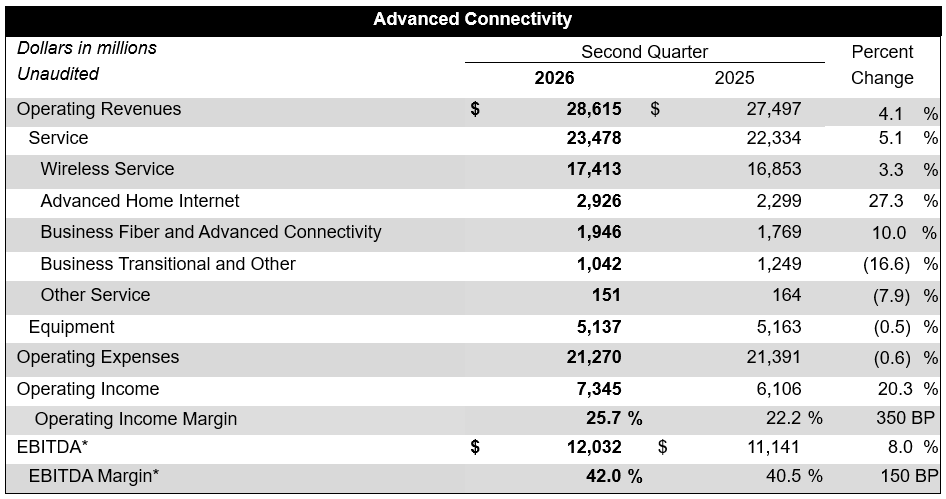
Advanced Connectivity segment revenues grew 4.1% year over year, driven by service revenue growth of 5.1%. Wireless service revenue increased due to growth in retail wireless subscribers in underpenetrated categories and converged accounts, and pricing actions that were partially offset by promotional discounts on wireless subscriber additions. Advanced home internet revenue growth, which included an impact from the acquired mass markets fiber business that closed in the first quarter, reflects increases in fiber and AT&T Internet Air revenues. Business fiber and advanced connectivity revenues increased largely due to higher fiber and fixed wireless revenues. Business transitional and other revenues decreased partly due to lower demand for virtual private network and wholesale services.
Operating expenses were down 0.6% year over year, due to lower depreciation expense from fully depreciated legacy assets, partially offset by ongoing capital spending for strategic initiatives. Also contributing to the decline were cost reductions from transformation initiatives, lower content licensing fees, and tower transaction gains. These decreases were partially offset by higher advertising expense, incremental customer costs related to the acquired mass markets fiber business, and higher bad debt expenses driven by subscriber growth.
Operating income was $7.3 billion, up 20.3% year over year. EBITDA* was $12.0 billion, up $891 million year over year.
Legacy revenues continued to decline year over year in line with AT&T's goal to power down and stop providing service over the large majority of its domestic copper-based network by the end of 2029.
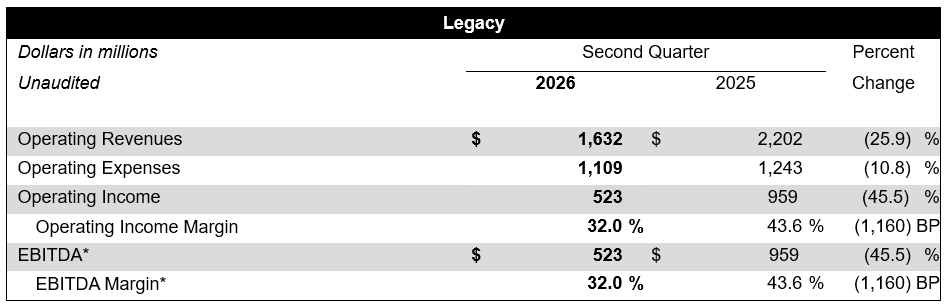
Legacy segment revenues were down 25.9% year over year, primarily due to lower demand for services as the Company continues to decommission its copper-based network. Operating expenses, which represent direct operating costs, were $1.1 billion, down 10.8% year over year. Expense declines were primarily driven by lower personnel and other costs resulting from the decommissioning of the copper-based network, and lower fulfillment cost amortization, partially offset by vendor settlements. Operating income and EBITDA* were $523 million, down $436 million year over year.
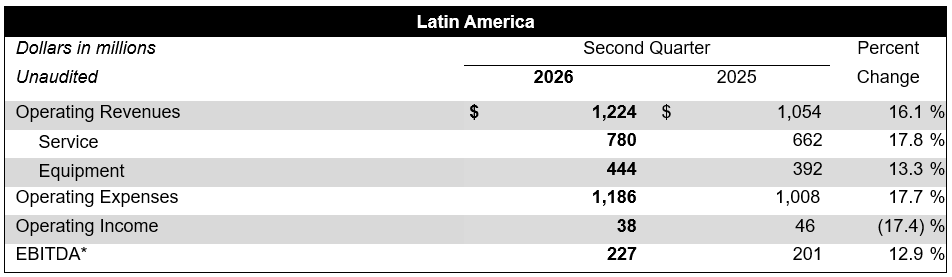
Latin America segment revenues were up 16.1% year over year, primarily driven by favorable foreign exchange rates and postpaid wireless subscriber growth. Operating expenses were up 17.7% year over year due to unfavorable foreign exchange rates, higher bad debt expense, and higher depreciation expense. Operating income was $38 million, down $8 million year over year. EBITDA* was $227 million, up $26 million year over year.
Read more Investor Relations news